You type in your address, answer a few questions, and 15 seconds later you’re staring at a roof replacement estimate. No phone calls, no waiting for a contractor to drive out, no pressure. It sounds almost too good to be true.
So, is it?
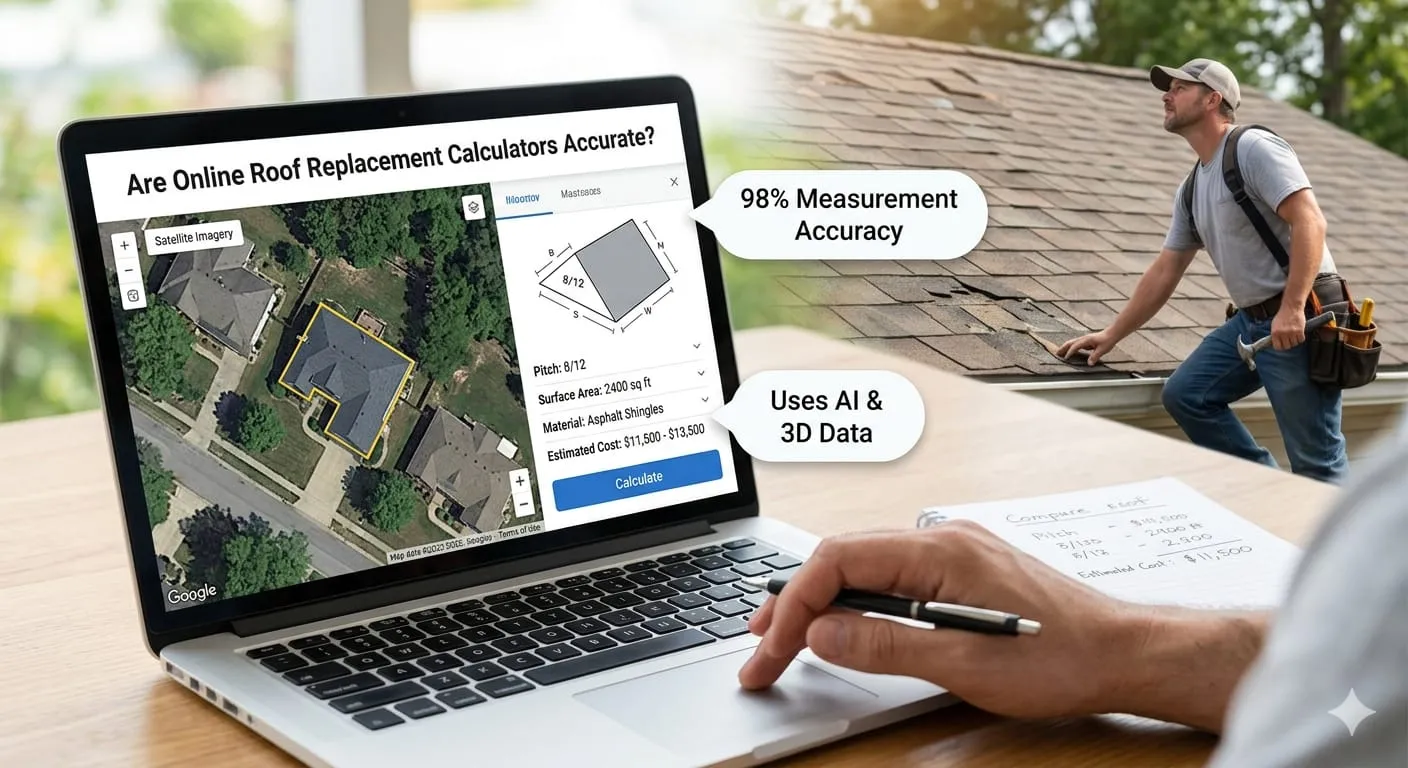
Online roof replacement calculators have gotten remarkably good in recent years. Instant Roofer claims roughly 98% measurement accuracy using AI and 3D aerial data. That’s an impressive number. But before you use an online estimate to budget your next roof project, it’s worth understanding exactly what that accuracy means, and where it stops. This article breaks down how these tools work, what they get right, where they fall short, and how to use them wisely so you don’t end up with a budget gap when the project starts.
How Online Roof Calculators Estimate Costs
Address, measurements, and pricing assumptions
Most online roof replacement calculators follow a similar process. You enter your address, select your roof type and preferred material (asphalt shingles, metal, tile, etc.), and the tool gets to work.
Tools like Instant Roofer go further than simple area math. They pull aerial imagery and 3D data to calculate your roof’s geometry, including pitch, slope, and total surface area. That data feeds into a pricing model that factors in material costs and general labor rates to produce an estimate in seconds.
The result feels precise. And for measuring square footage, it often is. But cost estimates are a different story, and that distinction matters more than most homeowners realize.
Measurement Accuracy vs. Price Accuracy: What the Numbers Mean
Instant Roofer reports an average measurement error of about 54 square feet. To put that in perspective, one bundle of shingles covers roughly 33 square feet, so a 54-square-foot error works out to less than two bundles. For most standard roofs, that’s a minor rounding difference, not a budget-breaker.
That’s the measurement side of accuracy. The cost side is a different equation entirely.
Pricing assumptions built into any online roofing calculator are based on averages. They account for materials and basic labor, but they can’t account for what’s actually going on with your specific roof. Local labor rates vary significantly by region. Material costs shift with supply chain conditions. And neither of those variables touches the hidden costs that only surface once a contractor gets eyes on your roof in person.
Measurement accuracy and cost accuracy are not the same thing. Knowing the difference will keep your budget realistic.
What Instant Roofer Measures Well (and Why)
For what it’s designed to do, Instant Roofer does it well. The AI measurement technology gives you a consistent, data-driven square footage calculation that doesn’t rely on rough estimates or guesswork. That consistency is one of its strongest advantages.
When you’re comparing quotes from multiple contractors, having an independent measurement as a reference point is genuinely useful. It gives you a baseline so you can spot outliers. A contractor quoting 40 squares when the AI measured 28 is a conversation worth having before you sign anything.
The tool also speeds up the early stages of the process. Instead of waiting for three separate contractors to schedule site visits just to get ballpark numbers, you can walk into those conversations already knowing your roof’s approximate size and a rough cost range. That’s time saved, and you’ll be better prepared than most homeowners who walk in cold.
For contractors, the embed feature adds another layer of value. A roofing cost estimator built into your website gives visitors an instant reason to stay, engage, and convert, and research consistently shows that embedded calculators improve lead quality because people who use them have already started thinking seriously about their project.
Common Calculator Blind Spots and Hidden Costs
This is where the honest conversation starts. No online roof replacement calculator, regardless of how sophisticated its AI is, can see what’s hiding underneath your shingles.
Roof decking damage is one of the most common cost surprises in any replacement project. When old shingles come off and a contractor finds rotted or compromised decking underneath, those boards have to be replaced before anything new goes down. That cost doesn’t appear in any estimate generated from aerial data.
The same goes for underlayment condition, flashing around chimneys and skylights, and any structural issues lurking below the surface. These aren’t rare edge cases; they’re common findings on older roofs that have dealt with years of heat, moisture, or storm damage.
Permits are another variable most calculators leave out entirely. Permit fees vary by city and county, and in some jurisdictions they add hundreds of dollars to the project total. Complex roof features, including dormers, multiple penetrations, and steep-pitch sections, also increase labor time in ways that flat-rate calculators can’t accurately model.
Roofing professionals are consistent on this point: calculators become misleading the moment a homeowner treats them as a final quote rather than a starting point. Budget overruns are most common when the inspection step gets skipped.
When to Trust an Instant Estimate: Homeowner Checklist
An online estimate is a research tool, not a contract. Use it in the early stages of your project to get oriented, compare material options, and set a rough budget range. It’s also useful for vetting quotes; if a contractor’s number is dramatically higher or lower than the calculator’s output, ask why.
Before you sign anything or commit to a contractor, get a professional inspection. This matters most if your roof is more than 15 years old, has visible damage, or has never been fully replaced. A qualified inspector will catch the hidden issues no calculator can.
Quick checklist before you finalize your roofing budget:
- Confirm the calculator’s square footage against the contractor’s measurement
- Ask how waste factors and pitch adjustments are calculated
- Request a line-item estimate that separates materials, labor, and disposal
- Ask the contractor to inspect decking and underlayment before locking in a price
- Get at least two in-person quotes before committing
- Confirm who pulls permits and whether the fee is included in the bid
One number worth keeping in mind: a 54-square-foot measurement variance equals roughly one to two bundles of shingles. On a simple ranch-style roof, that’s a minor difference. On a larger or more complex roof, small variances can compound quickly.
How Contractors Can Use Embedded Calculators to Win Leads
For roofing contractors, an embedded online roof replacement calculator is more than a convenience feature on your website. It’s a lead qualification tool.
Visitors who come to your website are already engaged. They see that you have an online calculator and that’s a plus in your favor. They’ve entered their address, considered their material options, and seen an estimated number. By the time they submit their contact information, they’re much further along in the decision-making process. That translates to better conversion rates for you and your customer feels more confident in their choices.
Instant Roofer’s embed option makes this easy to set up without custom development. A homeowner using your calculator is a homeowner who’s already thinking seriously about replacing their roof. It’s a perfect match up.
Quick Takeaway
Online roof replacement calculators like Instant Roofer are genuinely useful, especially for early-stage research, rough budgeting, and measurement verification. But an instant estimate is not a substitute for an on-site inspection when your final cost is on the line. Use the calculator to start the conversation, then bring in a professional to finish it.