
Skip to content
Data-Driven Accuracy

Instant Roof Measurements
With ~97% Accuracy

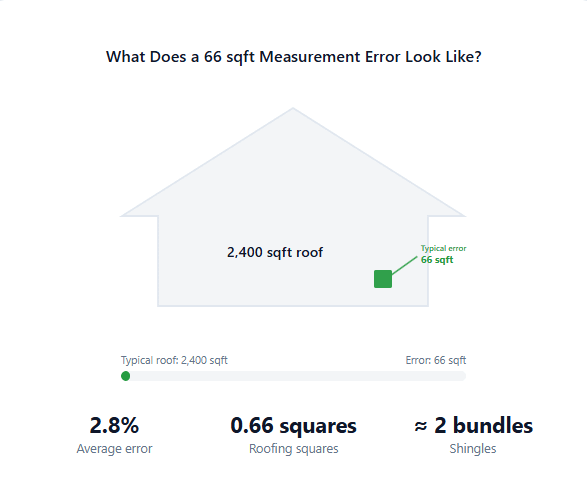
Average error just 66 sqft across thousands of manually measured roofs.
📝 70% more accurate since 2024 and still improving
Example showing what a 66 square foot roof measurement error looks like

Validated using real roof measurements

Tested against thousands of manually measured roofs
Accuracy improving with every model release
Highest accuracy on typical residential homes

Average measurement error across thousands of manually measured roofs.

Always Improving

70% More Accurate Since 2024 And We're Not Done Yet

Average error reduced from 231 sqft to 66 sqft, with a target of 33 sqft by Jan 2027.

We project reaching 33 sqft average error by Jan 2027, approximately 1 bundle of shingles across all roof sizes.

Model Validation

Predicted Roof Size vs Actual Roof Size

Points clustered near the diagonal line indicate high prediction accuracy.

Perfect prediction
±66 sqft error band

Each point represents a roof measured by the AI system and compared against a manually measured roof.

Error Distribution

84% of Roofs Measured Within 100 Sqft Accuracy

The vast majority of measurements land well under our 66 sqft average error, with most roofs achieving over 95% accuracy.

The distribution shows most predictions cluster under 100 sqft error, with only a small tail above 200 sqft.

By Roof Size

Highest Accuracy On Typical Residential Homes

Smaller residential roofs show the highest accuracy. Larger roofs tend to have more architectural complexity, which increases variance.
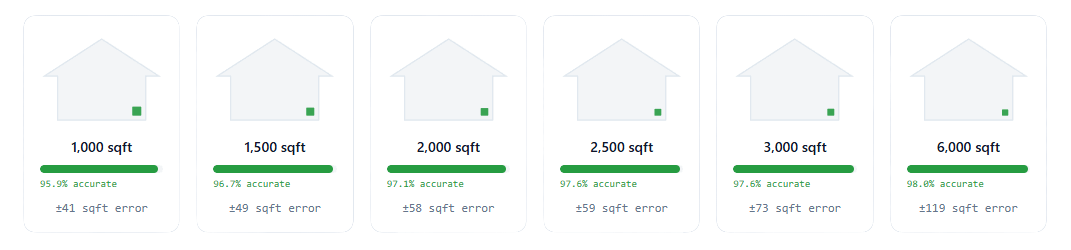
Roof measurement accuracy by roof size examples

Our smallest roof bucket is already close to 1-bundle accuracy. As models improve, we expect all residential sizes to reach this goal.

Methodology

How Accuracy Is Tested

Mean Absolute Error represents the average difference between the AI measurement and the manually measured roof size.

Predictions are compared against manually measured roofs.
We evaluate accuracy using dozens of metrics. Mean Absolute Error (MAE) is currently the primary one.
Results are broken down by roof size, region, and complexity to identify where the model performs best and where it can improve.
Deep Dive

Technical Details

For investors and technical readers looking for more depth.

Our evaluation dataset consists of thousands of residential roofs that have been manually measured by professional estimators. Each address is geocoded and matched against our AI predictions to compute error metrics.
Models are trained on high-resolution aerial imagery combined with 3D data. We use a combination of computer vision and deep learning techniques to detect roof planes, edges, and penetrations. Each model iteration is trained on an expanded and improved dataset.
Complex roofs with many facets, dormers, valleys, and penetrations present more opportunities for measurement variance. Simple hip and gable roofs are inherently easier to measure precisely. Larger structures also tend to have more architectural complexity.
We use Mean Absolute Error (MAE) as our primary metric. For each roof in the evaluation set, we calculate the absolute difference between the AI predicted area and the manually measured area, then average across all roofs. This gives a single, easy to understand number representing average measurement error in square feet.
Most measurement providers rely on 2D satellite imagery with assumptive pitch calculations and standardized waste factors. Instant Roofer uses actual 3D data to measure roof geometry, eliminating the guesswork involved in estimating pitch and waste from a flat image. This means our measurements reflect the true surface area of the roof rather than a mathematical estimate based on assumed angles. Additionally, our models are continuously evolving. We release new model versions regularly, and each release delivers measurable accuracy improvements.
Based on our current improvement trajectory, we project reaching an average error of 33 sqft (approximately 1-bundle of shingles) across all roof sizes by late 2026 to early 2027. For smaller residential roofs (under 1,300 sqft), we're already very close at 41 sqft average error. We expect the smallest roof buckets to reach 1-bundle accuracy with our next few model releases, while larger and more complex structures will take longer due to increased architectural complexity.

See the Accuracy for Yourself

Start a free trial and compare our measurements against your own.